Prisma3d: Tripo 3D Mesh Review—Watertight, Every Normal Faces Inward
prisma3d readers learn how Tripo’s 3D mesh performs against SupaVoxel on watertightness, topology, normals, support area, and print readiness.
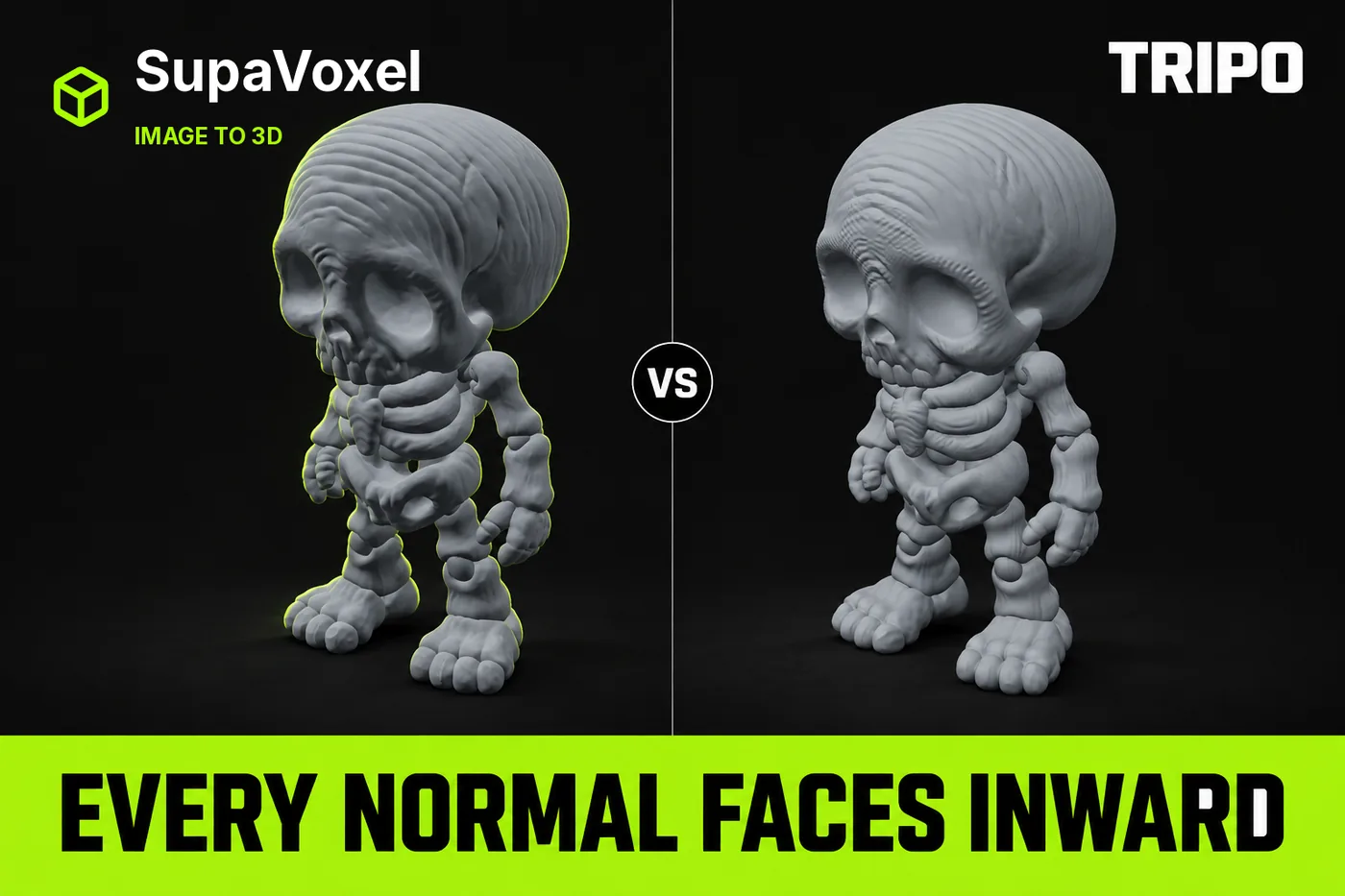
For prisma3d readers evaluating 3D reconstruction and printable meshes, this review explains what Tripo’s output gets right, where its normals fail, and how it compares with SupaVoxel in an independent offline test.
This is an independent test. Nothing here came from vendor access: both tools were used on my own free and paid accounts.
My verdict in 60 seconds — Tripo 62/100, SupaVoxel 88/100
I ran one photograph of a ball-jointed toy skeleton through Tripo and through SupaVoxel, both on stock product defaults, and then tore both GLBs apart offline at a 120 mm target height. This is not a sweep. Tripo wins the topology row outright and Tripo wins the invented back. It loses everything that touches the invoice, and it hands you a mesh whose faces all point the wrong way.
- Watertight after welding — Tripo yes · SupaVoxel no · Tripo's row, no argument
- Boundary edges (holes) — Tripo 0 · SupaVoxel 0 · tie, neither file has a hole to patch
- Non-manifold edges — Tripo 0 · SupaVoxel 375 · Tripo wins, and 375 is the worst number SupaVoxel posted in this case
- Face winding consistent — Tripo no · SupaVoxel yes · SupaVoxel wins, a slicer reads Tripo's file as a non-solid
- Connected shells — Tripo 2 · SupaVoxel 251 · Tripo wins, Euler characteristic −12 against SupaVoxel's 222
- Sliver faces — Tripo 16 · SupaVoxel 26 · Tripo wins by 10 triangles a slicer will fight
- Support area at 45° — Tripo 3,573 mm² (13.52%) · SupaVoxel 3,940 mm² (14.88%) · Tripo wins by 366.7 mm²
- Resin at 120 mm — Tripo 121.89 cm³ / $4.27 · SupaVoxel 121.28 cm³ / $4.24 · three cents apart
Four things a print shop should know before it pays Tripo 55 credits for this file:
- Tripo's mesh is closed and manifold, and it is still not slice-ready — the winding is inconsistent, so the slicer calls it a non-solid and you flip every normal by hand before anything else happens.
- Tripo shipped this file with Clean Topology switched off, because that is the default and because it is rationed at Trial ×2. The winding defect sits exactly where that switch would have been.
- Tripo's 1,961,102 triangles average 0.1922 mm per edge, already 2.1× finer than a 0.4 mm FDM nozzle. SupaVoxel's 978,322 triangles average 0.2772 mm and are still 1.4× finer than the nozzle. Neither file can be printed at the density it was generated at.
- On the back of the skull and pelvis — the part the input photo never showed — Tripo invented something more bone-like than SupaVoxel did. That is a real loss for SupaVoxel on this case's own stress axis, and I am not going to bury it.
For a printable 120 mm articulated skeleton, I would take the SupaVoxel file: both meshes enter a repair tool exactly once, both print to the same 121 cm³ of resin, and one of them costs 3 credits instead of 55.
The input: one photo, no back, 120 mm target
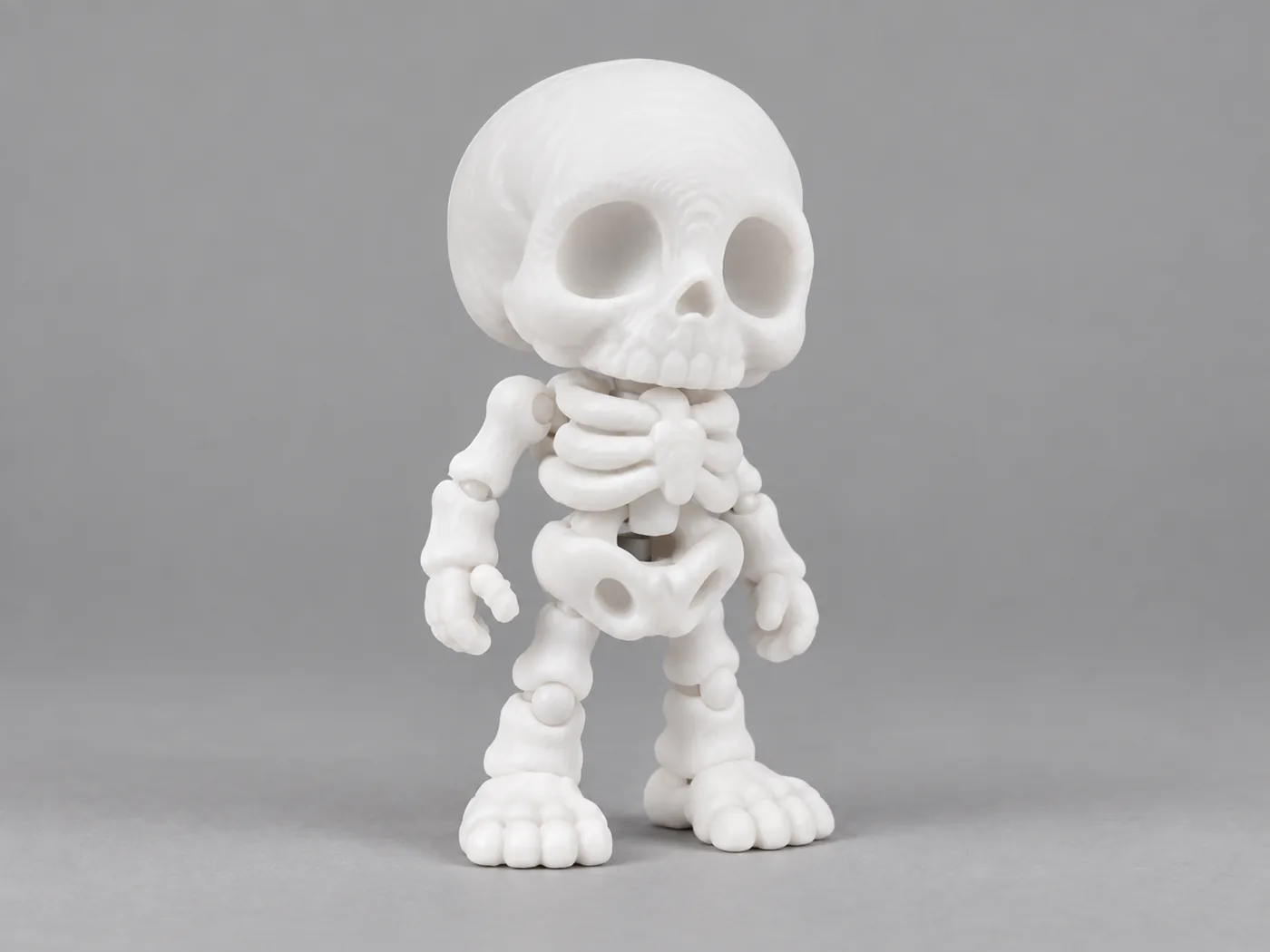 The single file both tools received: 1,373,847 B, sha256 197445ba…, grey studio backdrop, front view only. The spine, scapulae and rear pelvis are not in this photo at all.
Same file, same product defaults, same offline render rig, same camera positions. Tripo exports at yaw 0 and SupaVoxel at yaw 90, so every paired render below applies that offset — neither tool got to pick a flattering angle.
Both meshes kept the ball joints separate
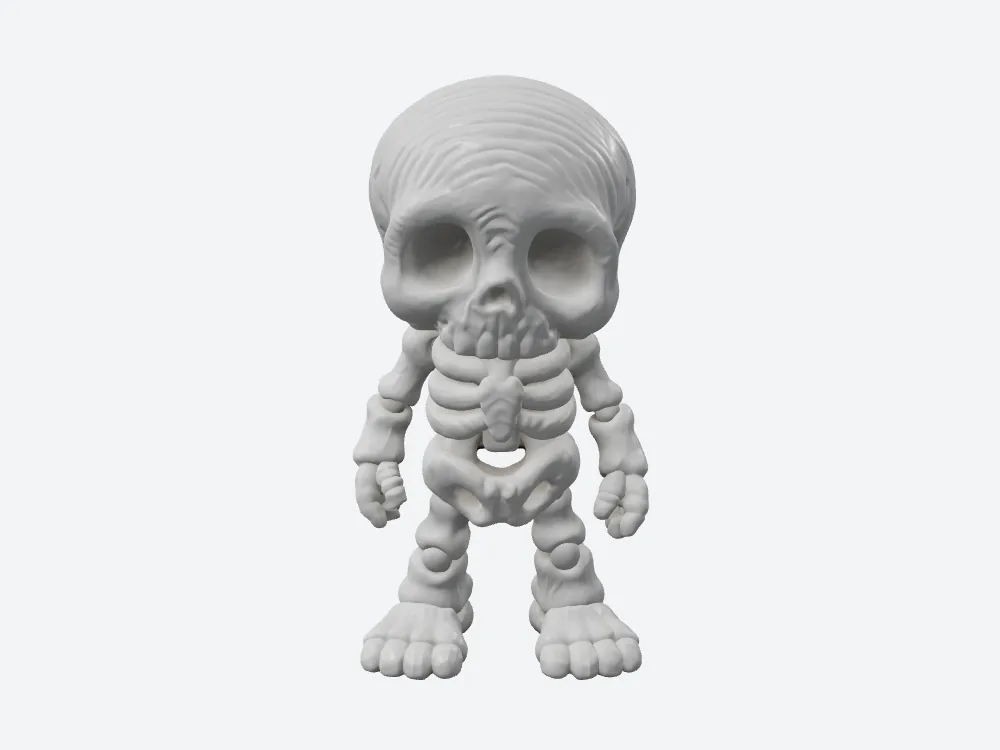 SupaVoxel at 978,322 triangles: elbows, wrists, knees and ankles are discrete bulges, the rib arches are individually separated, the pelvic aperture is open.
The headline risk for an articulated toy is fusion — limbs welded into one column. Neither Tripo nor SupaVoxel fused anything. Tripo passed this at 1,961,102 triangles; SupaVoxel passed it at exactly half that, 978,322. The joint test costs 55 credits on one side and 3 on the other.
Tripo's extra triangles land on the face and the hands
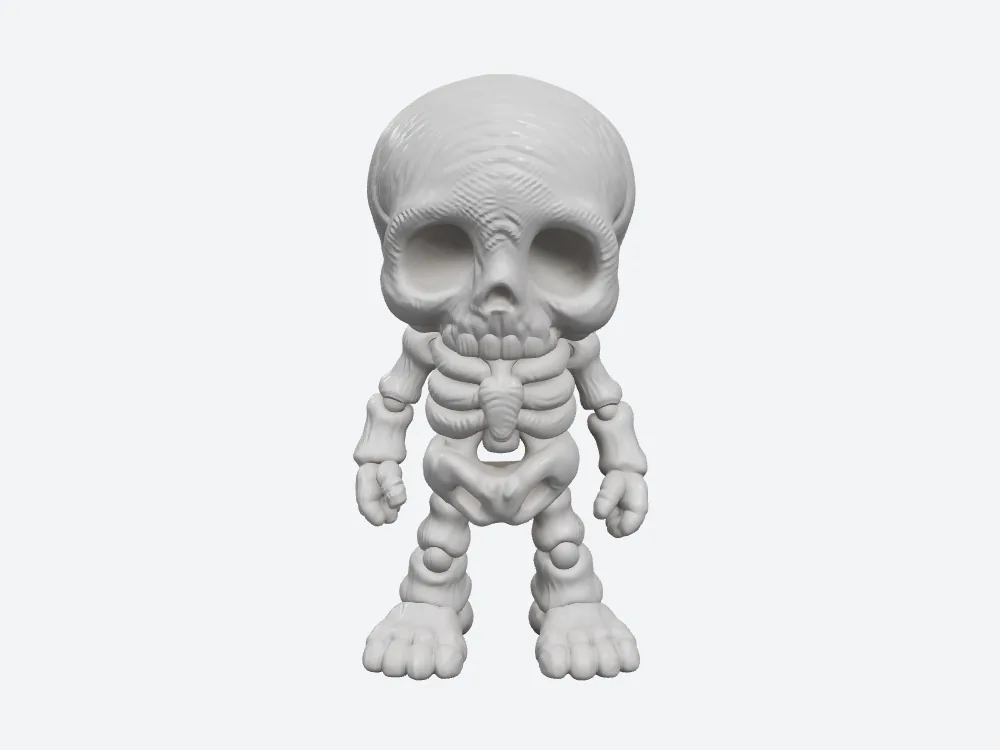 Tripo, same camera: individually countable teeth, a hard cheekbone transition, a defined sternal ridge, three distinguishable finger segments.
This is what Tripo's 982,780 extra triangles bought, and it is worth naming precisely: facial and hand micro-features. Not joints, not proportion, not structure. At the 120 mm target those features sit at 0.1922 mm — below what a 0.4 mm nozzle resolves. Tripo charges 18.3× the credits for detail the printer erases.
Tripo's mesh is genuinely closed
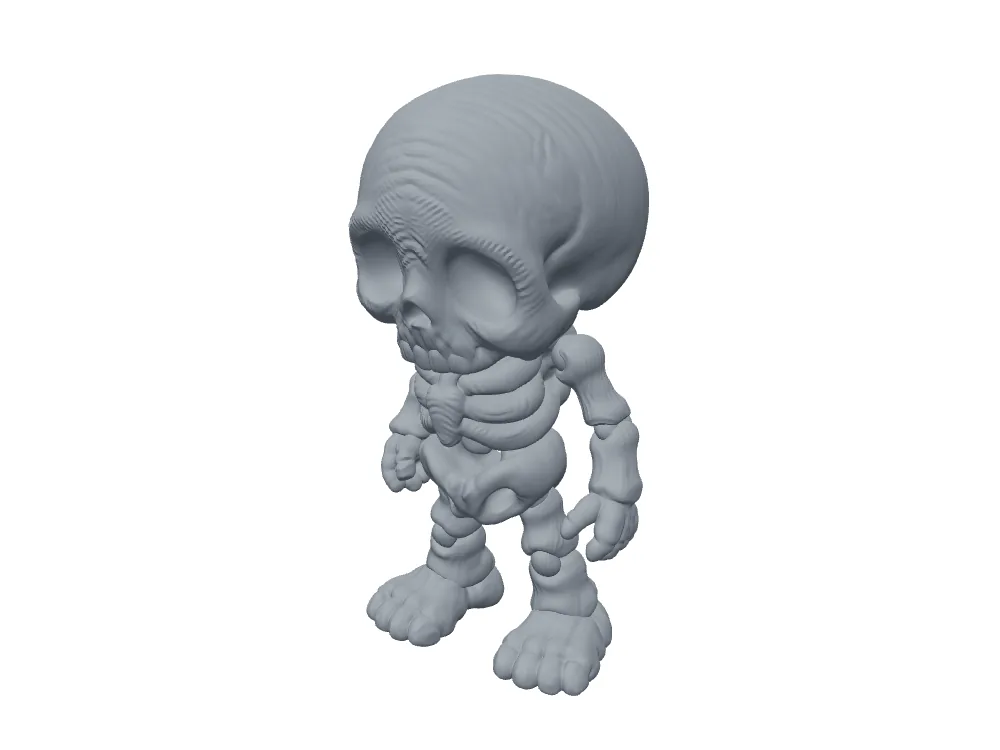 Tripo's untextured geometry. After welding by position: watertight = yes, boundary edges = 0, non-manifold edges = 0, connected components = 2.
Credit where it is due. Tripo hands over a two-shell, hole-free, manifold body. If your downstream is an automated slicer or a CAD boolean that refuses hand-repaired meshes, Tripo wins this row and nothing else in this article changes that.
And then every face points the wrong way
 Tripo's studio row before submit: Best Quality selected, Clean Topology carrying a Trial ×2 badge and switched off. This is the state 55 credits bought.
Tripo's welded winding is inconsistent — some faces are inside-out. A slicer reads that as a non-solid and stops. So the closed manifold shell you just paid for still goes into a repair tool for a global normal flip. Tripo's topological perfection is worth exactly zero steps saved.
SupaVoxel's mesh: winding consistent, 375 non-manifold edges
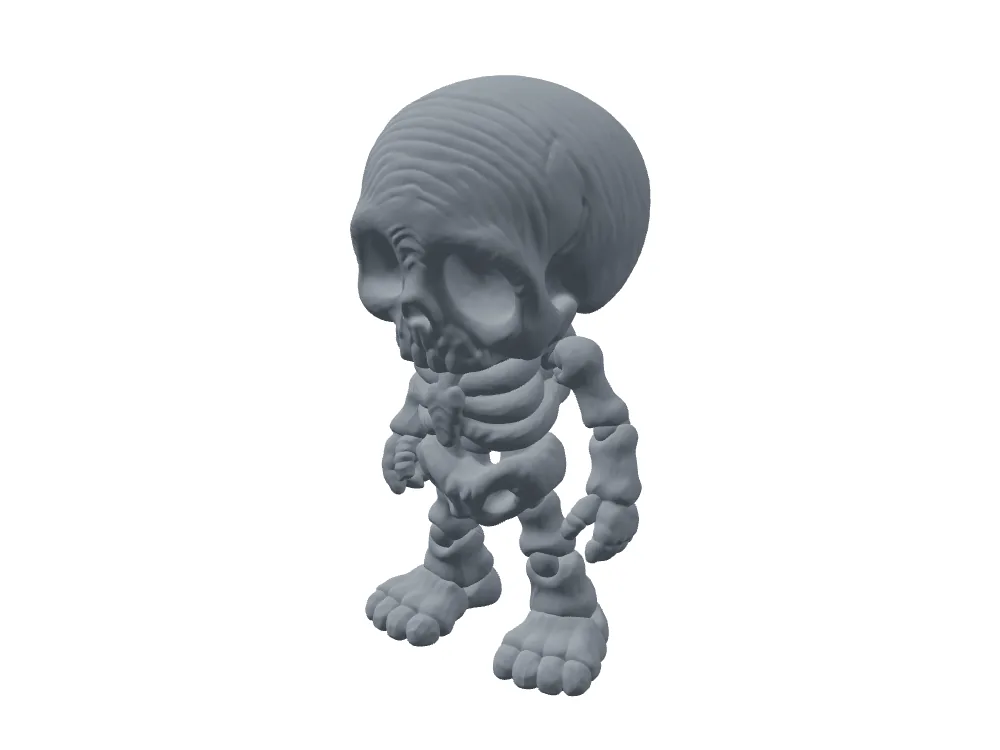 SupaVoxel untextured: consistent winding, 0 boundary edges, 0 degenerate faces — and 375 non-manifold edges across 251 connected shells.
The SupaVoxel file is not watertight and Tripo's is. 375 non-manifold edges is the ugliest number I recorded in this case, and it means a mesh-repair pass before slicing. The Tripo file needs a normal flip; the SupaVoxel file needs a manifold repair. One tool visit each. The step count is 1:1. The 52-credit difference does not buy you "no repair" — it buys you "a different repair".
Euler characteristic 222 against −12
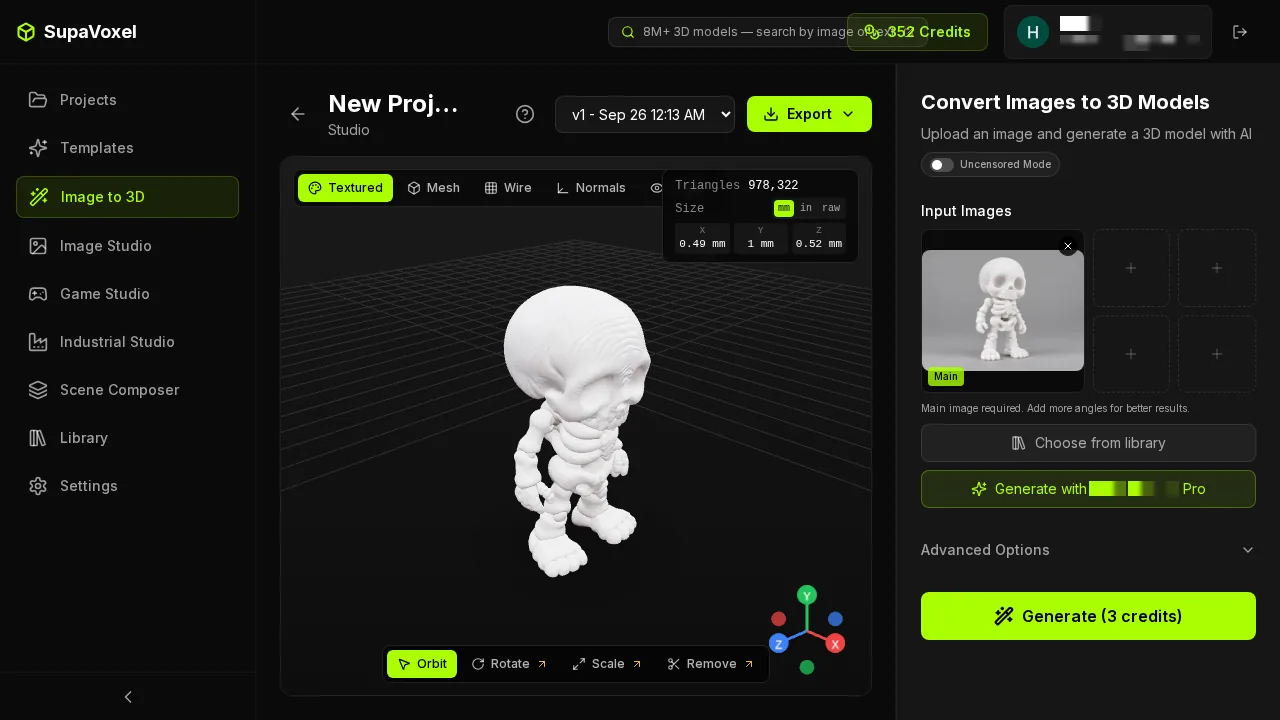 SupaVoxel's in-product inspection panel reads Triangles 978,322 — identical to what I parsed out of the GLB offline. Five view modes: Textured / Mesh / Wire / Normals / X-Ray.
251 shells against Tripo's 2, Euler 222 against Tripo's −12. Those 251 components are mostly small and most repair tools sweep them, but Tripo's 2-shell result is the cleaner starting point and I will not pretend otherwise. What it costs to get there: 55 credits versus 3, an 18.3× multiple, for a file you then re-orient anyway.
Sliver faces: Tripo 16, SupaVoxel 26
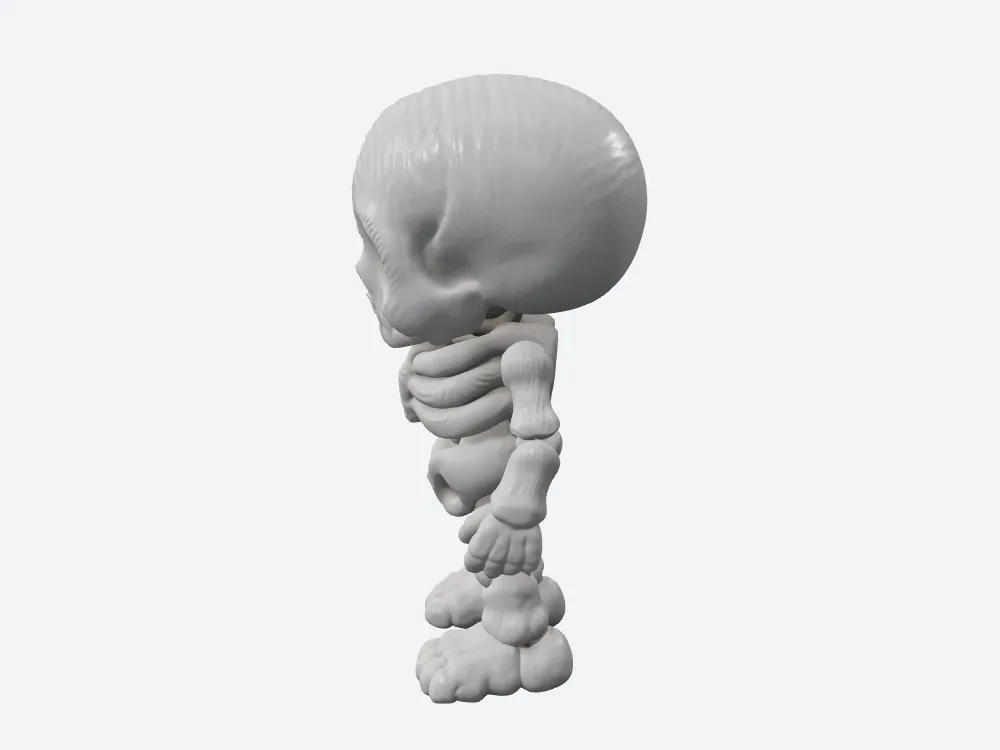 Tripo from the side: distinct temporal hollow, humerus / elbow ball / forearm reading as three separate contours.
Degenerate faces: zero on both sides. Sliver faces: Tripo 16, SupaVoxel 26. Slivers produce jagged boundaries and stray thin walls, so 26 is 10 more places a slicer can misbehave. Tripo's triangle hygiene is better here. The trade: those 10 triangles cost 52 extra credits and 56.5 MB of extra download.
Supports: SupaVoxel needs 366.7 mm² more
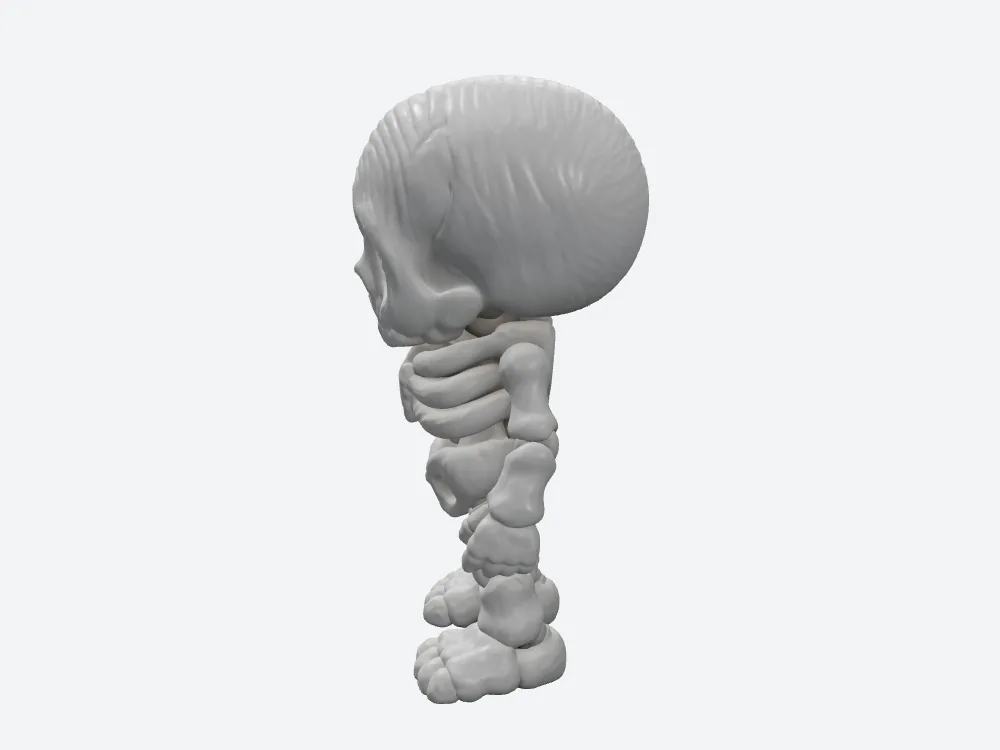 SupaVoxel from the side: softer jaw-to-ribcage transition, forearm contour merging into the torso near the chest, clean toe segments.
At a 45° threshold Tripo needs 3,573.2 mm² of support (13.52% of area) and SupaVoxel needs 3,939.9 mm² (14.88%). That is 366.7 mm² more, +10.3%. In resin at $35/L it is under five cents; in labour it is a slightly longer support-removal session. Tripo takes this row.
Mean edge length versus a 0.4 mm nozzle
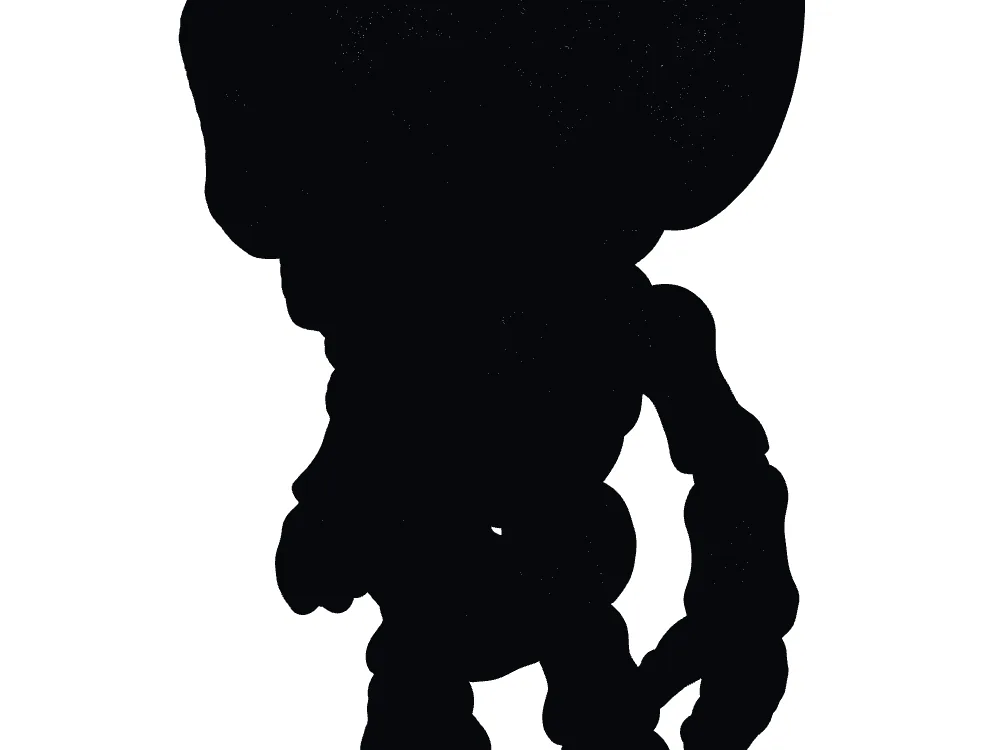 Tripo's wireframe at 1000×750. 1,961,102 triangles render as a solid black field — the mesh density is not humanly resolvable at this zoom.
Tripo averages 0.1922 mm per triangle edge, SupaVoxel averages 0.2772 mm, and an FDM nozzle is 0.4 mm. Tripo is 2.1× finer than the nozzle, SupaVoxel 1.4× finer. Both are past the machine's limit, which makes Tripo's triangle advantage unprintable by definition. The second-order number: 982,780 triangles priced at 52 extra credits, worth 0.000 mm of printed difference.
Volume and resin: three cents apart
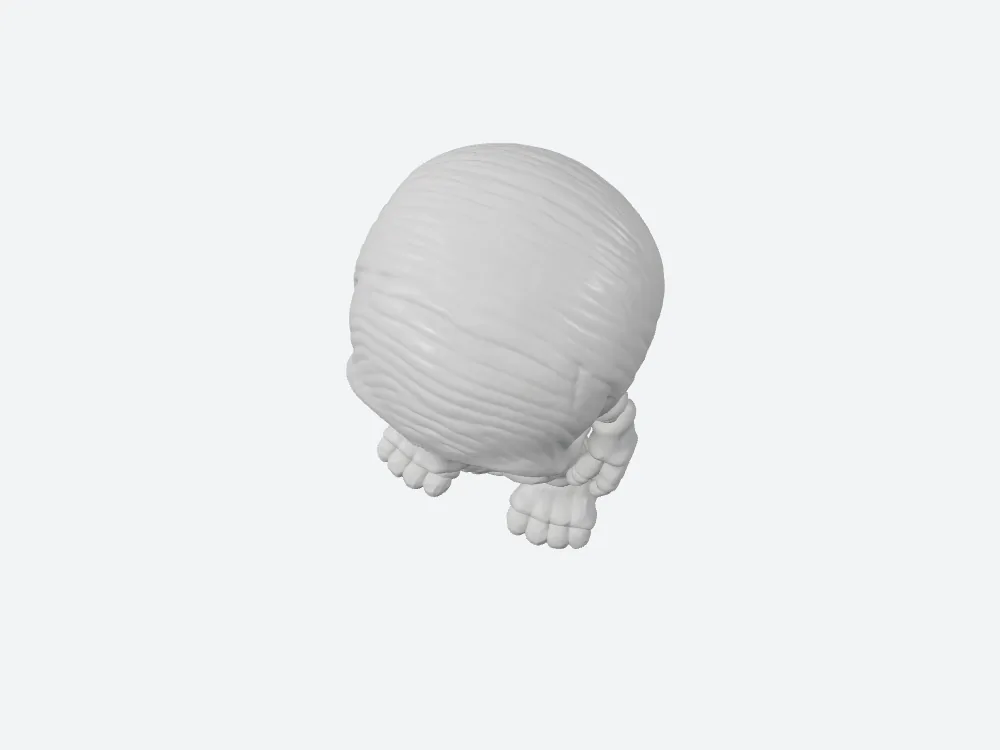 SupaVoxel from above. The transverse ripples on the cranium are the FDM layer lines from the input photograph, faithfully rebuilt as geometry by both tools.
Scaled to 120 mm, Tripo's solid measures 121.89 cm³ and SupaVoxel's 121.28 cm³. At $35/L that is $4.27 against $4.24. Tripo's 2.00× triangle count buys three cents of resin. Bounding boxes: Tripo 61.84 × 120.0 × 58.31 mm, SupaVoxel 59.13 × 120.0 × 62.19 mm — same object, same shelf.
The back neither tool could see — and Tripo did it better
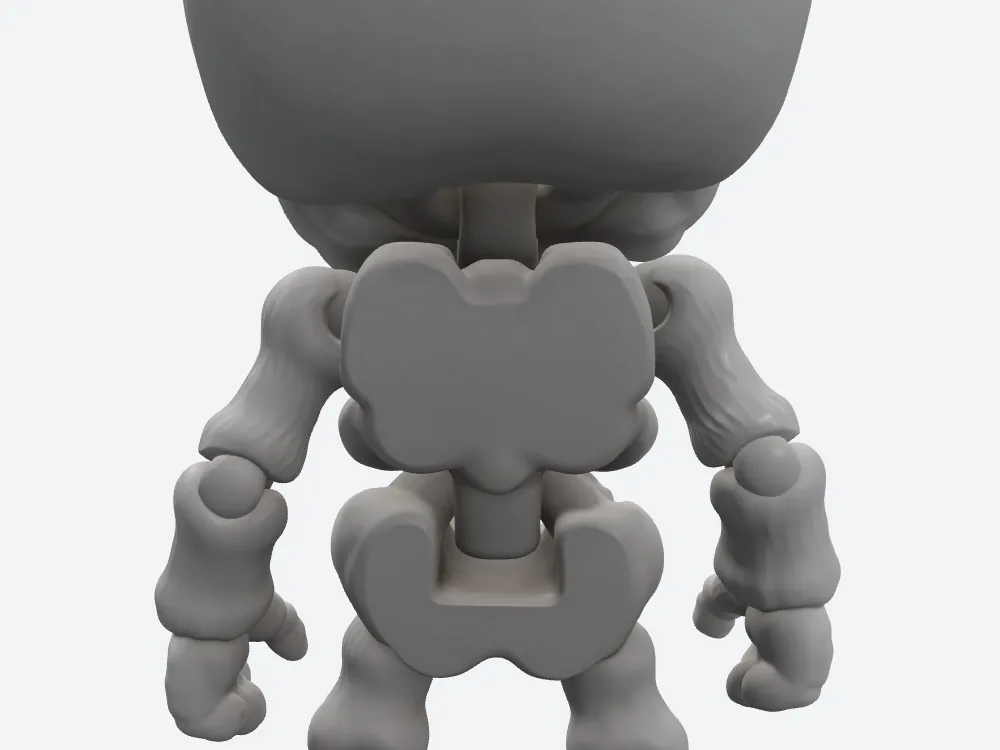 Tripo's invented back, zoomed: a soft butterfly contour reading as scapulae, a graded central groove, a short vertical column above the pelvis reading as lumbar vertebrae.
There is no spine in either model. Both tools invented this surface, because the input photo has no back. But Tripo's invention is anatomically more convincing than SupaVoxel's, and on a skeleton — where bone structure is the subject — that matters more than it would on a vase. On this case's own stress axis, Tripo wins. There is no trade ratio that makes that go away; the honest framing is that it costs 52 extra credits and a normal flip to buy a better guess at a surface that was never photographed.
SupaVoxel's back is a hard-edged plate with a rectangular window
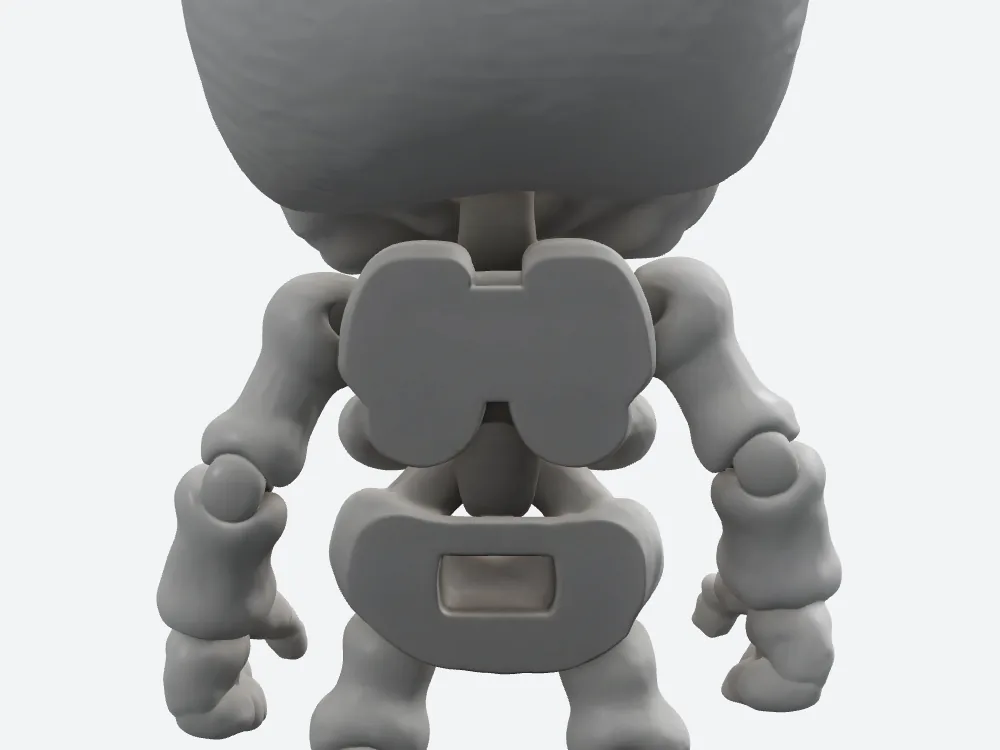 SupaVoxel's invented back: two hard-edged, filleted industrial plates, an H-shaped seam, and a rectangular recess on the pelvis with no anatomical counterpart at all.
That rectangular window is pure geometry, not biology. The limb joints survive the zoom intact — elbow ball and forearm stay separate — but the back panel is the weakest surface SupaVoxel produced in this case.
Getting the file out: Tripo's six formats, 2 steps
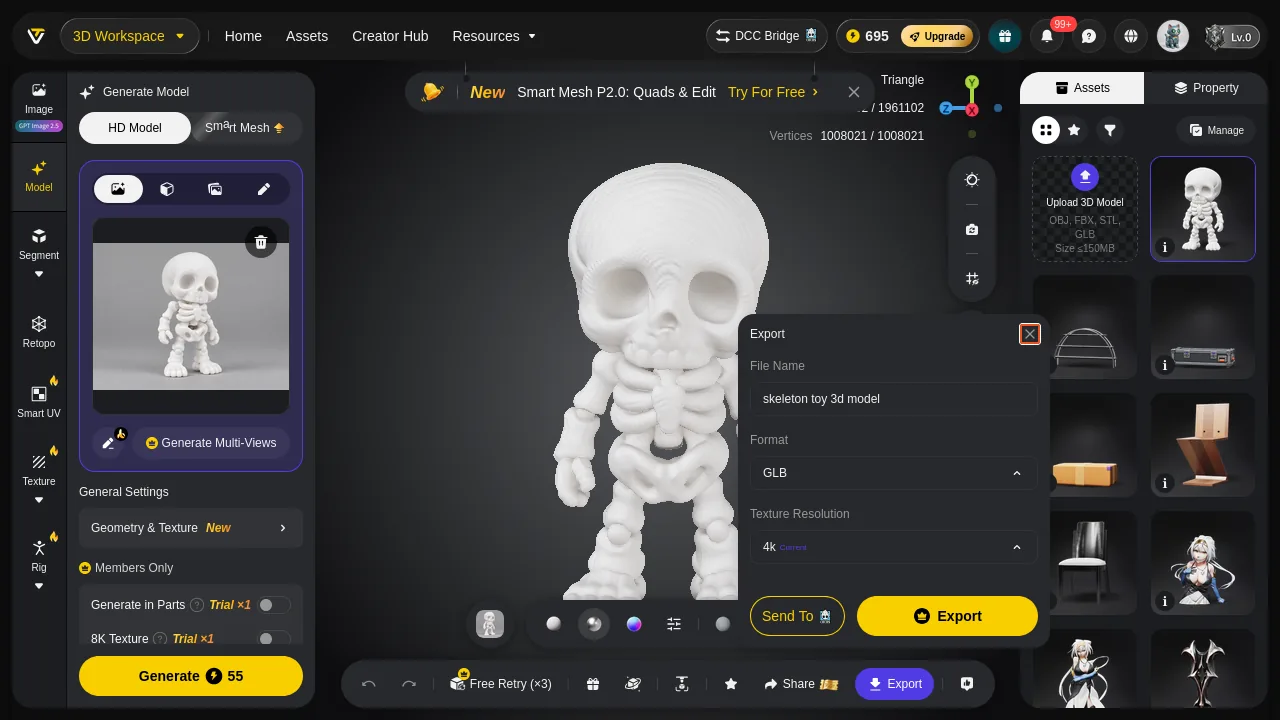 Tripo's export panel: File Name, a Format dropdown offering USD / FBX / OBJ / STL / GLB / 3MF, Texture Resolution 4k Current.
Six formats against the single GLB I took out of SupaVoxel, and Tripo reaches a file on disk in two clicks from the result view. That is a real Tripo advantage and it is on the board. I never expanded SupaVoxel's export dropdown in this run, so its format list and click count read "not captured" rather than a guessed number. One Tripo footnote: the download runs through a client-side blob URL that is revoked on click, so a second copy means walking the export panel again.
Final verdict: Tripo scores 62/100, SupaVoxel 88/100
Tripo earns its 62 on real ground: a closed manifold shell with 0 boundary edges and 0 non-manifold edges, 16 slivers against SupaVoxel's 26, 366.7 mm² less support area, and a back-surface invention that reads more like bone. Anyone who downloads both GLBs can confirm all five.
Tripo loses 38 points on the things that decide whether the file is usable: inconsistent winding that a slicer reads as a non-solid, Clean Topology defaulted off and rationed at Trial ×2, 0.1922 mm triangles a 0.4 mm nozzle cannot print, and 55 credits against 3 for a part that comes out of the printer at 121.89 cm³ instead of 121.28 cm³. Both files need one trip through a repair tool. Only one of them costs 18.3× to obtain.
Caveat, stated plainly: one generation per tool, product defaults, sample size 1. Every number here parses out of the two downloadable GLBs.
Which one I would use for this job
For a 120 mm articulated skeleton headed to a printer, the 3-credit path is the one I would repeat: consistent winding, 0 boundary edges, 0 degenerate faces, 5.54 MB, an in-product panel whose triangle count matches the GLB exactly, and the same 121 cm³ of resin at the end. Budget one mesh-repair pass for those 375 non-manifold edges — the other path budgets one normal flip, and charges 52 more credits for the privilege. Start at supavoxel.com.
Want to try it yourself?
Try Supavoxel →